

Manage Projects
Manage the projects that live inside your Enterprise Group
Your Enterprise plan includes access to your Enterprise Group, also known as a parent group, as well as related projects, referred to as child projects. The parent Enterprise Group manages multiple child projects under one dashboard and acts as a wrapper that provides a single custom domain and global landing page.
Need additional support? Contact your CSM or reach out to [email protected] at any stage of setup.
Group and Project Inheritance
A Enterprise Group provides shared functionality across all of its projects:
- Provide global CSS rules across all of your child projects.
- Provide global third-party integration settings across your child projects.
- Provide custom JavaScript across all of your child projects.
- Provide a global landing page to house the child projects under.
Set the custom domain in the parent Enterprise Group. Each child project shows up as a subpath in the URL after the custom domain.
URL Structure
Here is an example of a parent Enterprise Group URL structure with three child projects:
Add a Project to a Group
- Go to dash.readme.com and create a new project.

- Go to the Projects page in your Enterprise Group dashboard. This page lists all child projects currently associated with your Enterprise Group.
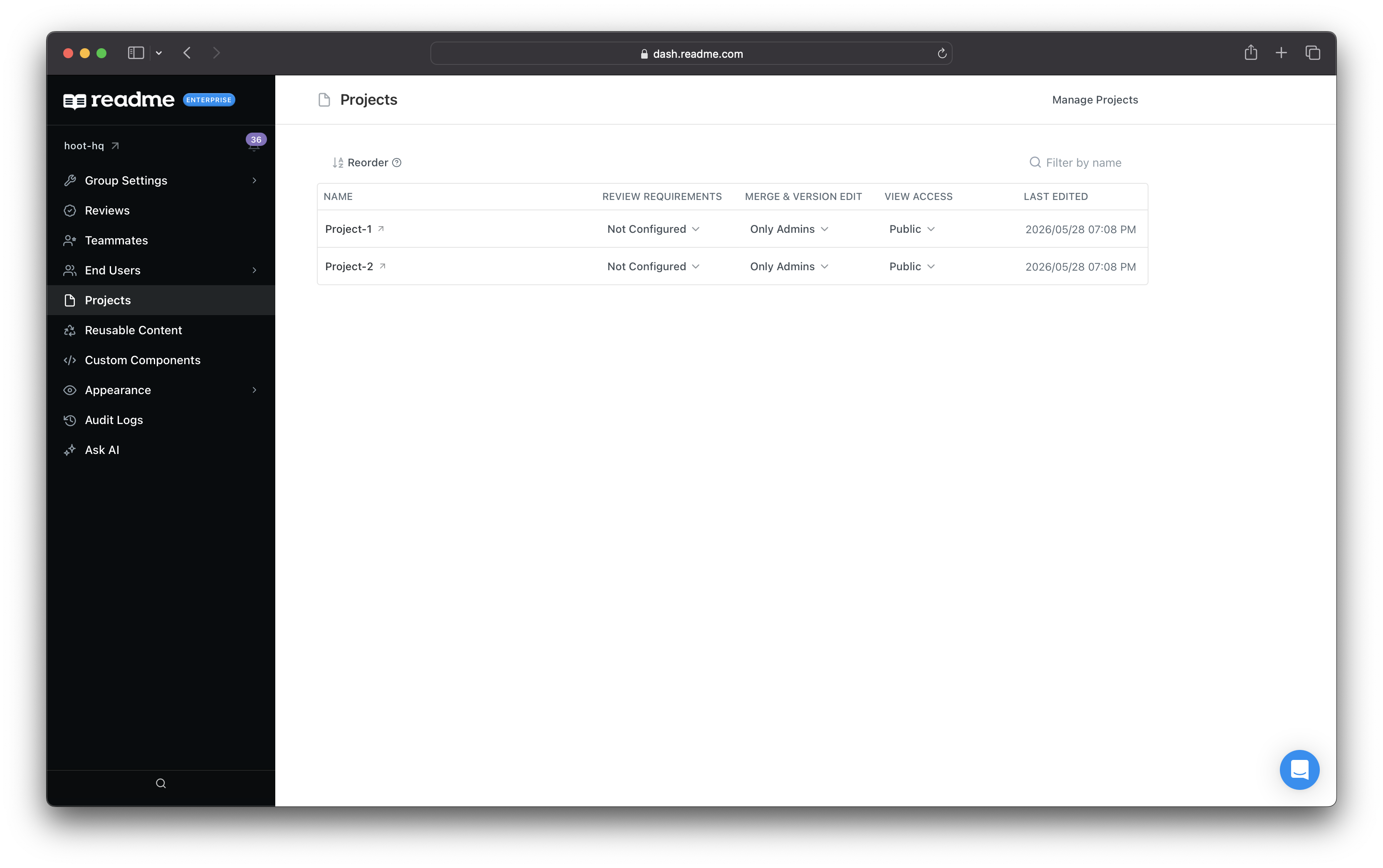
- Click Manage Projects to pull up a list of all child projects you have access to.
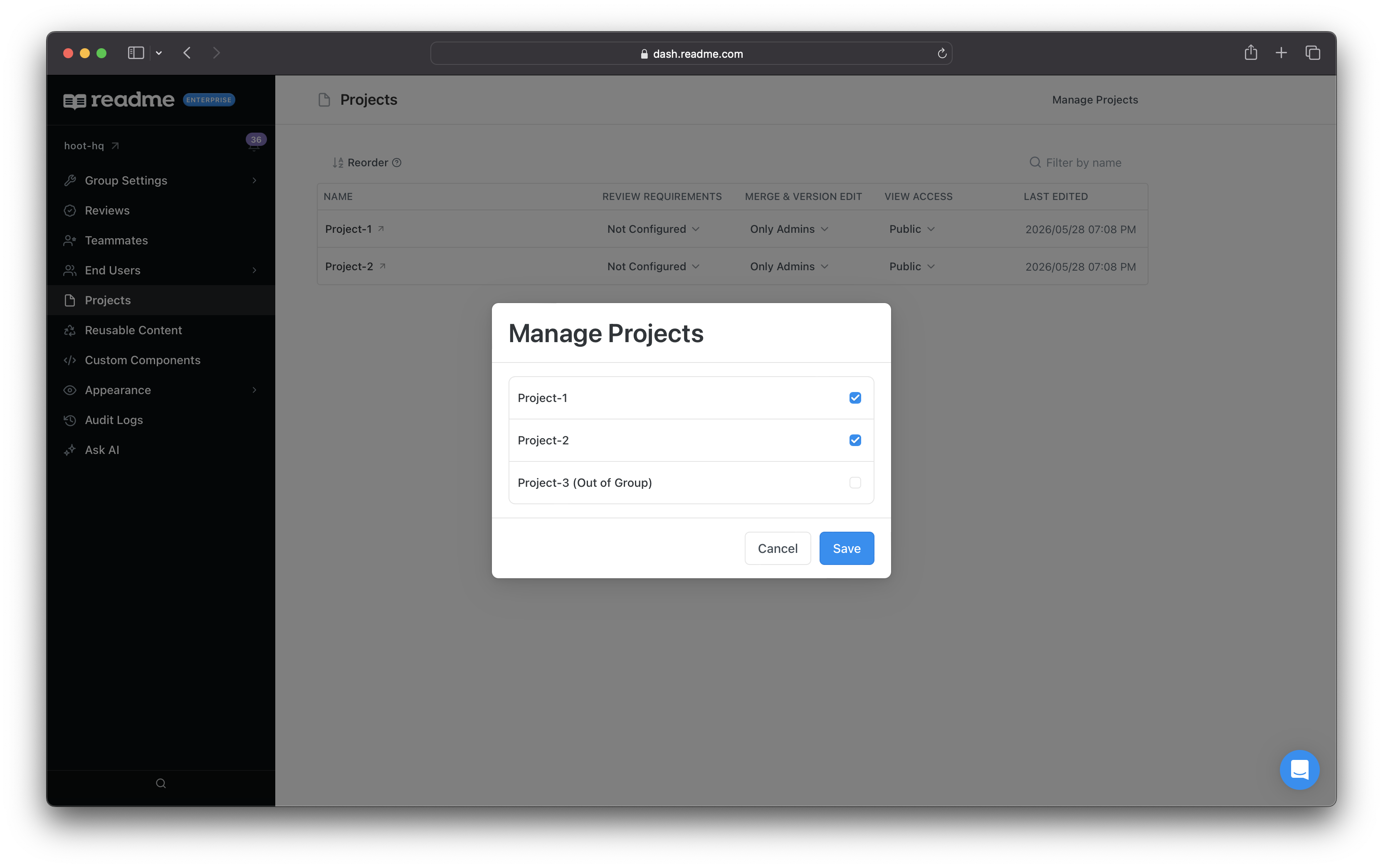
- Check the box next to the project you want to add and click Save to add it to your Enterprise Group. Once added, it appears on the Projects page of your Enterprise Group.
Remove a Project
To remove a child project, go to the Projects page in your Enterprise Group dashboard. Click Manage Projects, uncheck the box next to the project you want to remove, then click Save to remove it from your Enterprise Group.
Specify Project Path Names
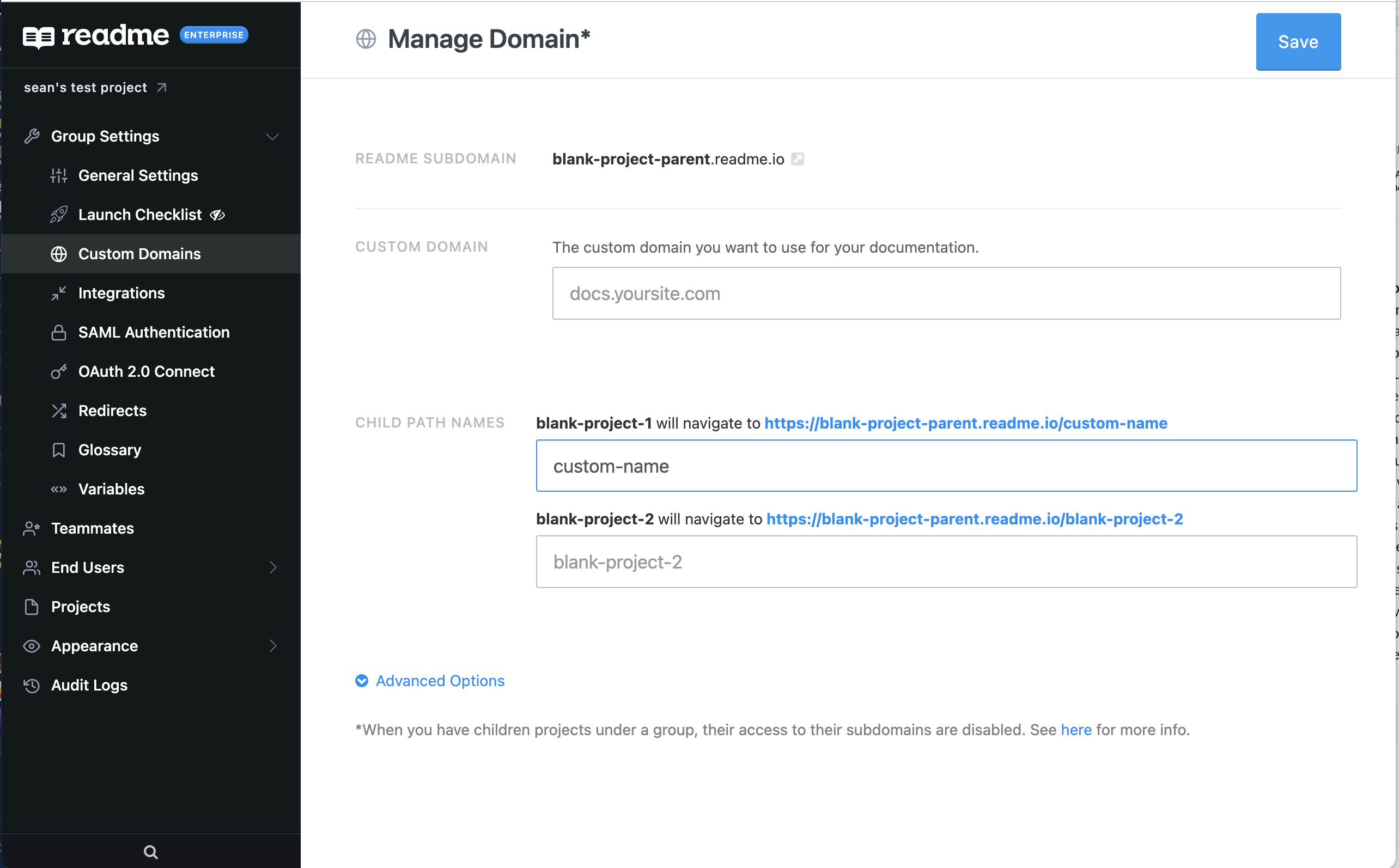
You can customize the URL structure for groups so that a project maps to a particular value.
By default, projects in a group map to a subdomain of the larger group domain. If your group's subdomain is parent-test and the child project's subdomain is child-test, a page URL maps to https://parent-test.readme.io/child-test.
If you customize the child path name to custom-name, that URL changes to https://parent-test.readme.io/custom-name. Navigate to the group custom domain view to set the child path names.
Updated last month