
AI Dropdown
Overview
The Ask AI Dropdown empowers your users with intelligent assistance directly within your documentation hub. This feature provides a suite of AI-powered tools and assistants that help users quickly find answers, understand complex concepts, generate code examples, and interact with your documentation in more meaningful ways, without leaving your docs.
By integrating AI capabilities into your documentation, you can:
- Reduce support burden by enabling users to get immediate answers to their questions
- Help developers understand complex API concepts through natural language explanations
- Provide a more interactive and personalized documentation experience
The Ask AI Dropdown appears as a menu icon within your guides pages, creating a seamless extension of your documentation experience.
How It Works
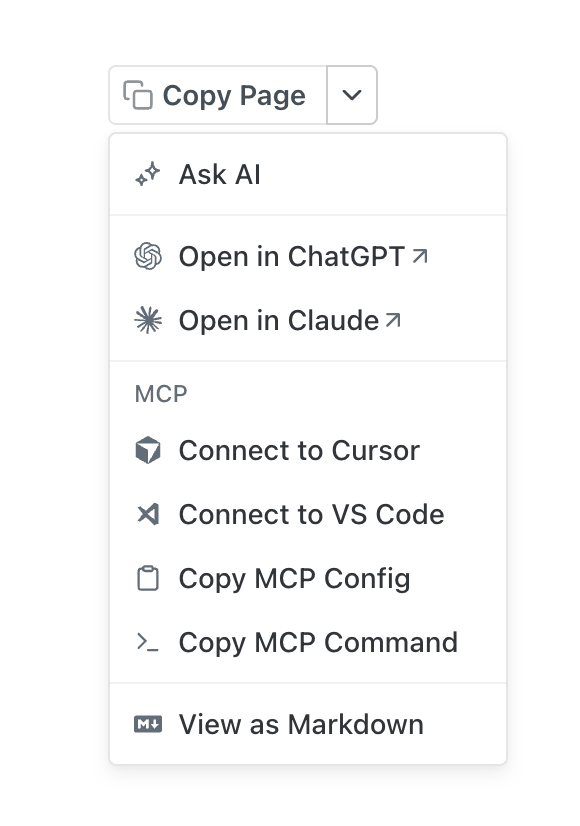
The Ask AI Dropdown is displayed as a menu icon in your guides pages. When clicked, it reveals a menu of AI tools and assistants that enhance your documentation experience.
The dropdown includes connections to AI assistants that analyze and understand your documentation content, utility tools for working with content in your workflow, and MCP connection options for customers with the ReadMe MCP server enabled.
Getting Started
ReadMe Refactored
- Click the AI Settings (Sparkle Icon) in the top right.
- Toggle Enable AI Dropdown to ON.
- Select which AI tools to include.
- Click Save.
ReadMe Legacy
- Go to Configuration > AI Features.
- Toggle Enable AI Dropdown to ON
- Select which AI tools to include.
- Click Save.
Available Tools & Integrations
AI Assistants
- ChatGPT Integration: Opens the current page in OpenAI's ChatGPT, trained on your documentation content, to answer user questions, explain concepts, and generate code examples specific to your API. ChatGPT excels at providing detailed explanations and step-by-step guidance based on your documentation.
- Claude Integration: Opens the current page in Anthropic's Claude, a conversational AI assistant that provides nuanced, helpful responses to questions about your documentation. Claude is particularly skilled at understanding context and providing thoughtful explanations of complex technical concepts.
MCP Connections
If you have the ReadMe MCP server enabled, customers visiting your docs will see additional MCP connection options in the AI Dropdown. These options allow users to connect your documentation directly to MCP-compatible AI tools and development environments, giving them inline access to your API documentation within their existing workflows.
To display MCP connections in the dropdown, enable the MCP server for your project. Once enabled, the connection options appear automatically in the AI Dropdown for your users.
- Copy Page: The default action in the dropdown. Copies the full page content in markdown format, making it simple to paste into AI tools, IDEs, or documents while preserving formatting.
- Copy Markdown: Copies the current page content in markdown format, making it easy to paste into AI tools, IDEs, or documents while preserving formatting.
- View as Markdown: Displays the underlying markdown of the current documentation page, which is helpful for developers who want to understand content structure or reference your documentation style.
MCP Connections
If your project has an MCP server enabled, the AI Dropdown automatically displays MCP connection options. This gives your users a quick way to discover and connect their AI coding assistants (Cursor, Claude Desktop, VS Code, etc.) to your project's MCP server directly from any docs page.
By providing these AI tools directly within your documentation, you create a more interactive, self-service experience that helps users get the most out of your API with minimal friction.
Updated about 11 hours ago